Brainspotting (MSP)
Talk therapy primarily engages the neocortex, the part of the brain responsible for conscious thought, reasoning, and language. While this can be incredibly valuable, it doesn’t always reach the deeper areas where trauma and distress are stored. Somatic approaches, such as Brainspotting (BSP), work differently.
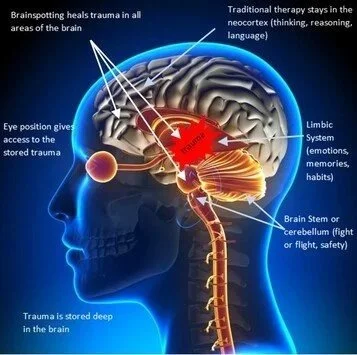
They access the subcortical brain, where experiences are held on a non-verbal, emotional, and physiological level, allowing for processing that goes beyond words.
Brainspotting works directly with the brain and body by engaging the autonomic and limbic systems within the central nervous system. Research in neurobiology suggests that unresolved experiences can become “stuck” in these deeper regions, limiting our ability to feel present, regulated, and fully ourselves. When that happens, it can show up as anxiety, depression, or a persistent sense of disconnection.
How Brainspotting is Used in a Session
Brainspotting is grounded in the idea that “where you look affects how you feel.” Specific eye positions are linked to stored emotional experiences. During a session, a practitioner helps you identify an eye position connected to a particular issue. By maintaining focus there, the brain and body are able to process and release the underlying emotional and physical activation, often without needing to verbalize every detail. Over time, this helps retrain the nervous system’s response to that experience. As these stored responses are processed, the intensity around them begins to resolve, allowing for a return to greater balance and optimal functioning.
Brainspotting has been shown to support individuals dealing with trauma, anxiety (including panic and performance anxiety), depression, creative and performance blocks, addiction and cravings, compulsive behaviors, unresolved grief, and medical trauma.